

Ukurasa huu unatafsiriwa. Maandishi ya Kiingereza yanaonyeshwa hadi toleo la Kiswahili litakapopitiwa na kuidhinishwa.
Facts, Value and Global Importance
Africa's Mineral Wealth
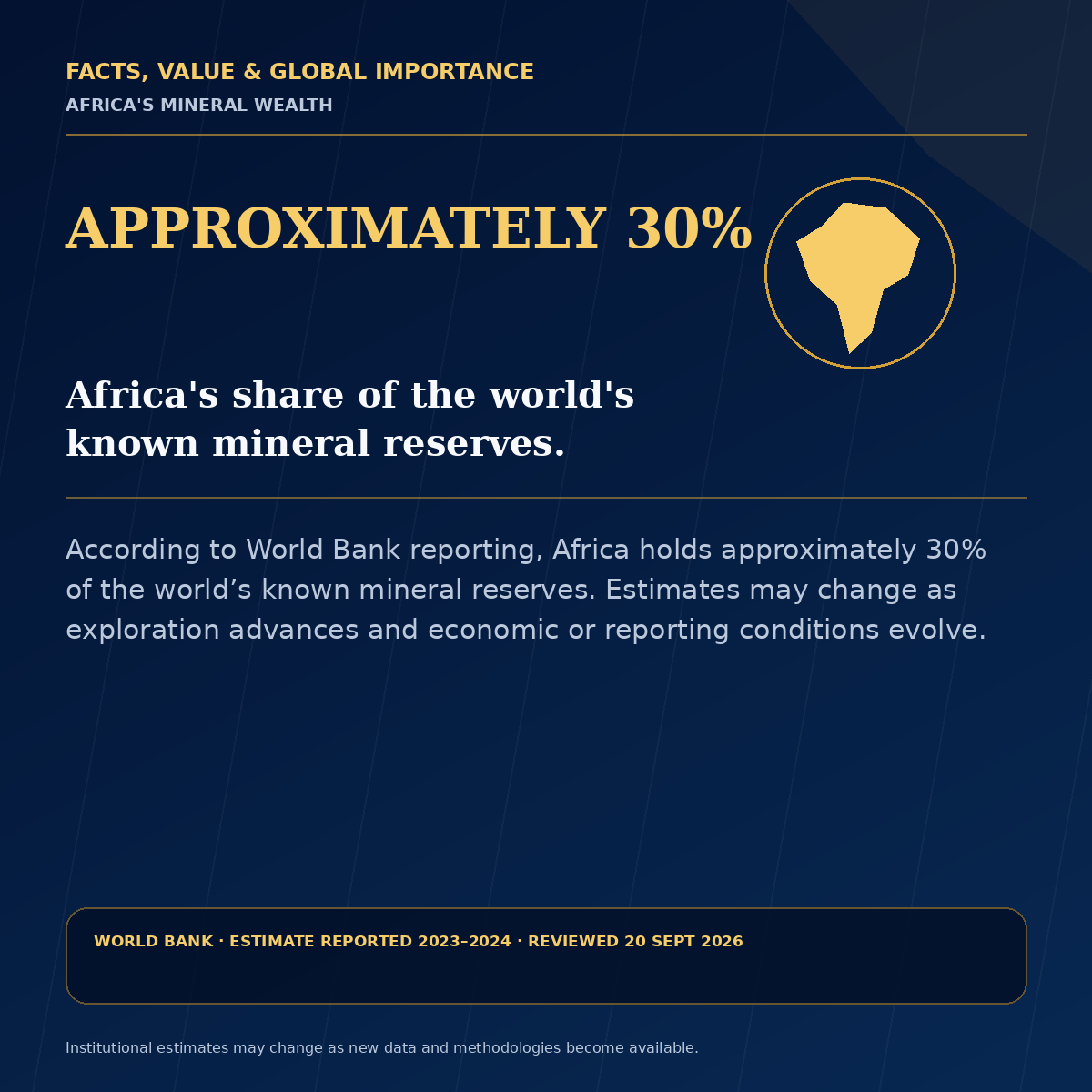
Africa is home to approximately 30% of the world's known mineral reserves and supplies resources that are essential to agriculture, infrastructure, manufacturing, technology and the global energy transition.
Key figures
Cited estimates, with their reporting year
Each figure below is an estimate published by the named source for the year shown. Estimates are revised as exploration, production, prices and reporting standards change, and must not be treated as permanent facts.
Statistics are based on institutional estimates available at the stated review date and may change as new data, exploration results and methodologies become available.
Important valuation statement
Mineral reserves do not have one fixed dollar value. Economic value depends on grade, recoverability, market prices, infrastructure, operating costs, legal rights, environmental and social obligations, financing conditions and country risk. Multiplying an underground estimate by the current refined-metal price does not constitute a credible project valuation.
Commodity by commodity
Where Africa matters to global supply
Cobalt in the Democratic Republic of the Congo
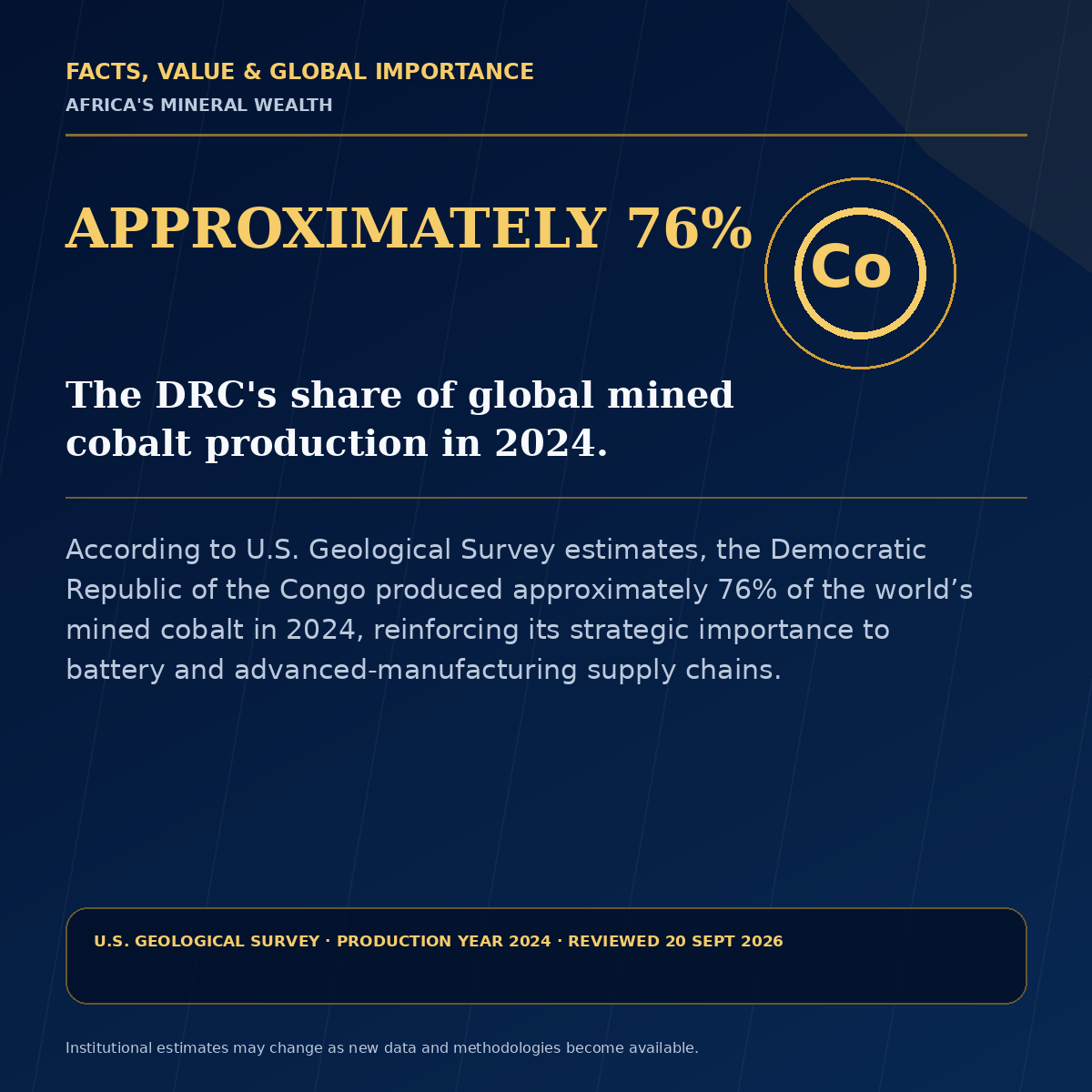
The Democratic Republic of the Congo is reported as the origin of approximately 76% of globally mined cobalt in the 2024 production year. Most of that cobalt is recovered as a by-product of copper mining in the south-eastern Copperbelt, which means cobalt supply is influenced as much by copper economics as by cobalt demand.
Cobalt is used in battery cathodes, superalloys and catalysts. Because a large share of supply originates in one country, buyers and manufacturers increasingly require documented mine of origin, chain of custody and artisanal-mining risk assessment before contracting. MIG applies enhanced due diligence to every cobalt opportunity.
Source: U.S. Geological Survey — Mineral Commodity Summaries
Copper in the DRC and Zambia
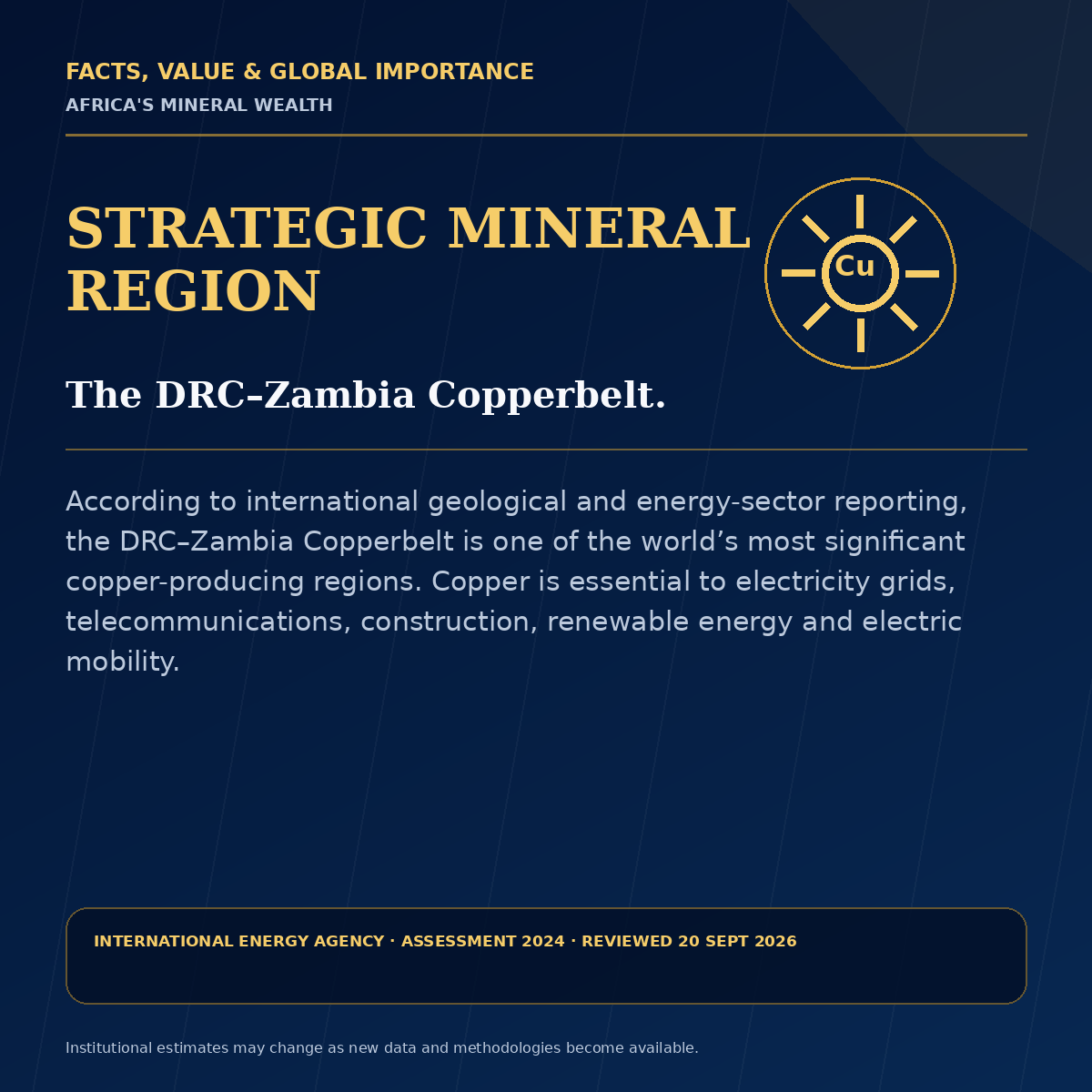
The Central African Copperbelt spanning the southern DRC and northern Zambia is one of the world's most significant copper regions, with grades that are high by international standards. Copper is central to electrification: grids, transformers, motors, renewable generation and electric vehicles all depend on it.
Copper projects in the region are constrained less by geology than by power availability, transport corridors, water, financing conditions and legal title. A credible copper opportunity therefore requires evidence on infrastructure and licensing, not only on grade.
Platinum-group metals in South Africa and Zimbabwe
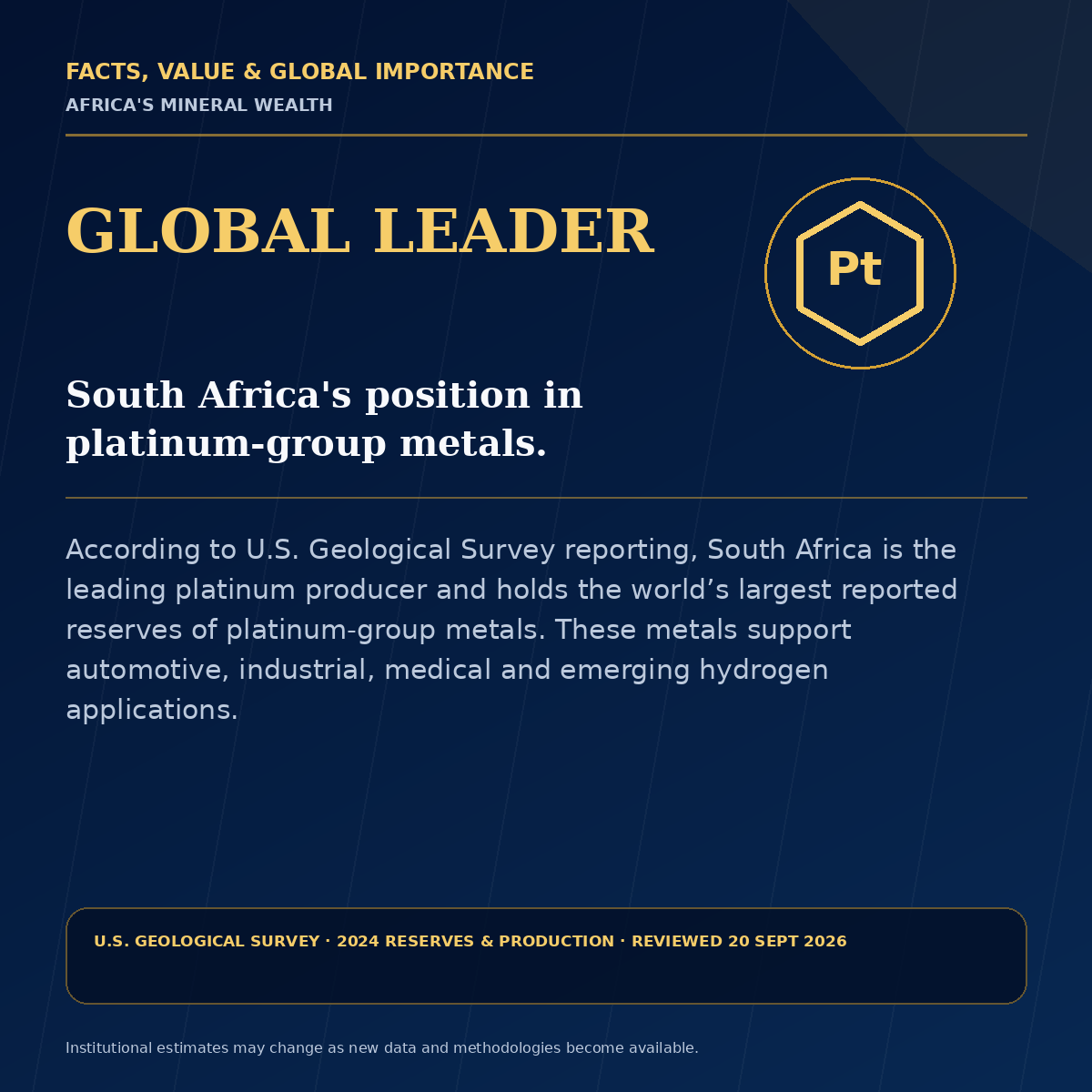
South Africa is reported as the global leader in platinum production and in platinum-group-metal reserves, hosted principally in the Bushveld Complex. Zimbabwe's Great Dyke is a further significant source of platinum, palladium and rhodium.
Platinum-group metals are used in autocatalysts, chemical processing, electronics, medical devices and hydrogen technologies including electrolysers and fuel cells. Production is sensitive to electricity supply, depth of mining, labour conditions and refined-metal prices.
Source: U.S. Geological Survey — Mineral Commodity Summaries
Phosphate resources in Morocco and North Africa
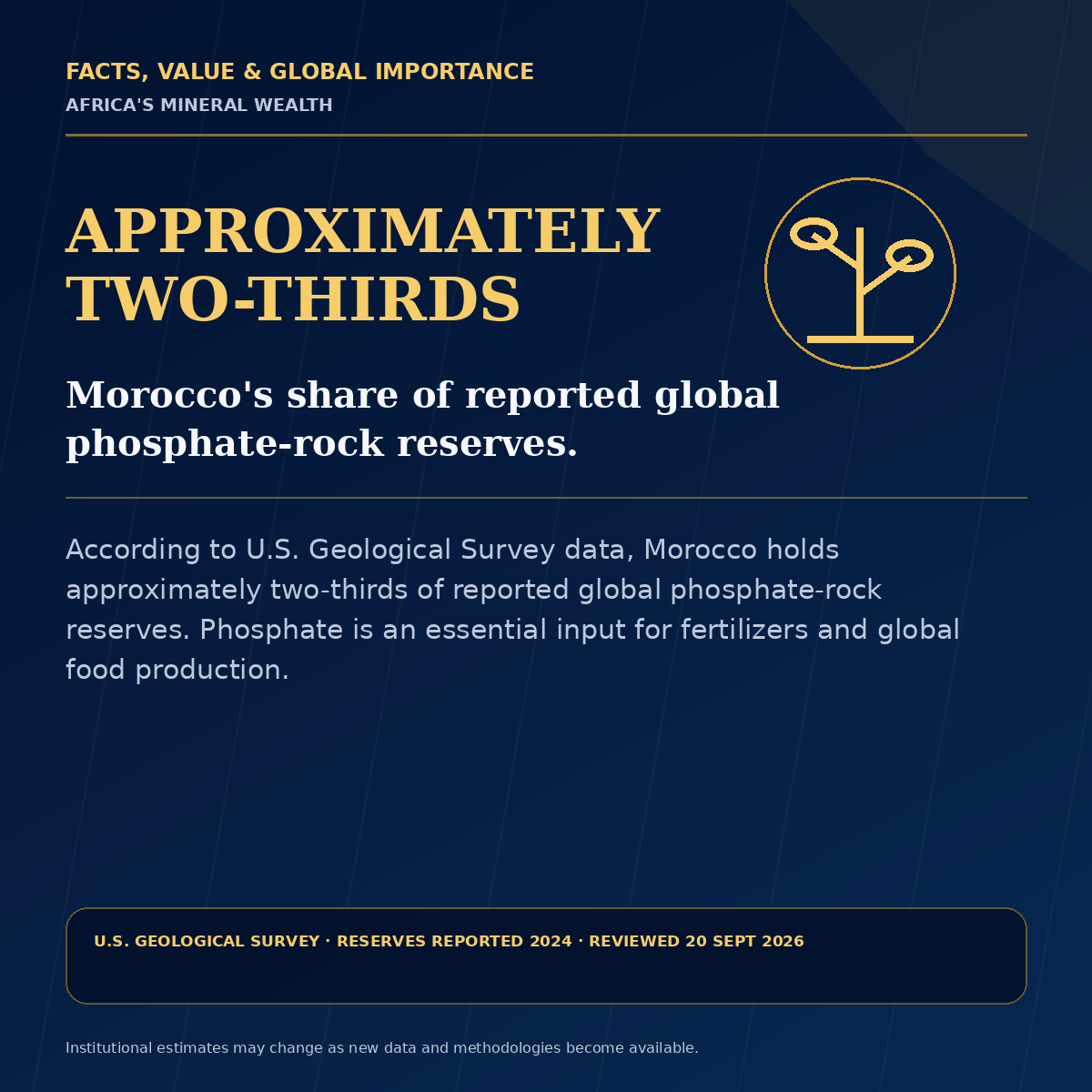
Morocco holds an estimated two-thirds of reported global phosphate-rock reserves, with further North African resources in Algeria, Tunisia and Egypt. Phosphate rock is the feedstock for phosphate fertilizers and therefore a foundation of global food security.
Value in phosphate is captured largely through processing into phosphoric acid and finished fertilizers rather than through the export of raw rock. Cadmium and other impurity levels materially affect market acceptance in certain jurisdictions.
Source: U.S. Geological Survey — Mineral Commodity Summaries
Bauxite in Guinea
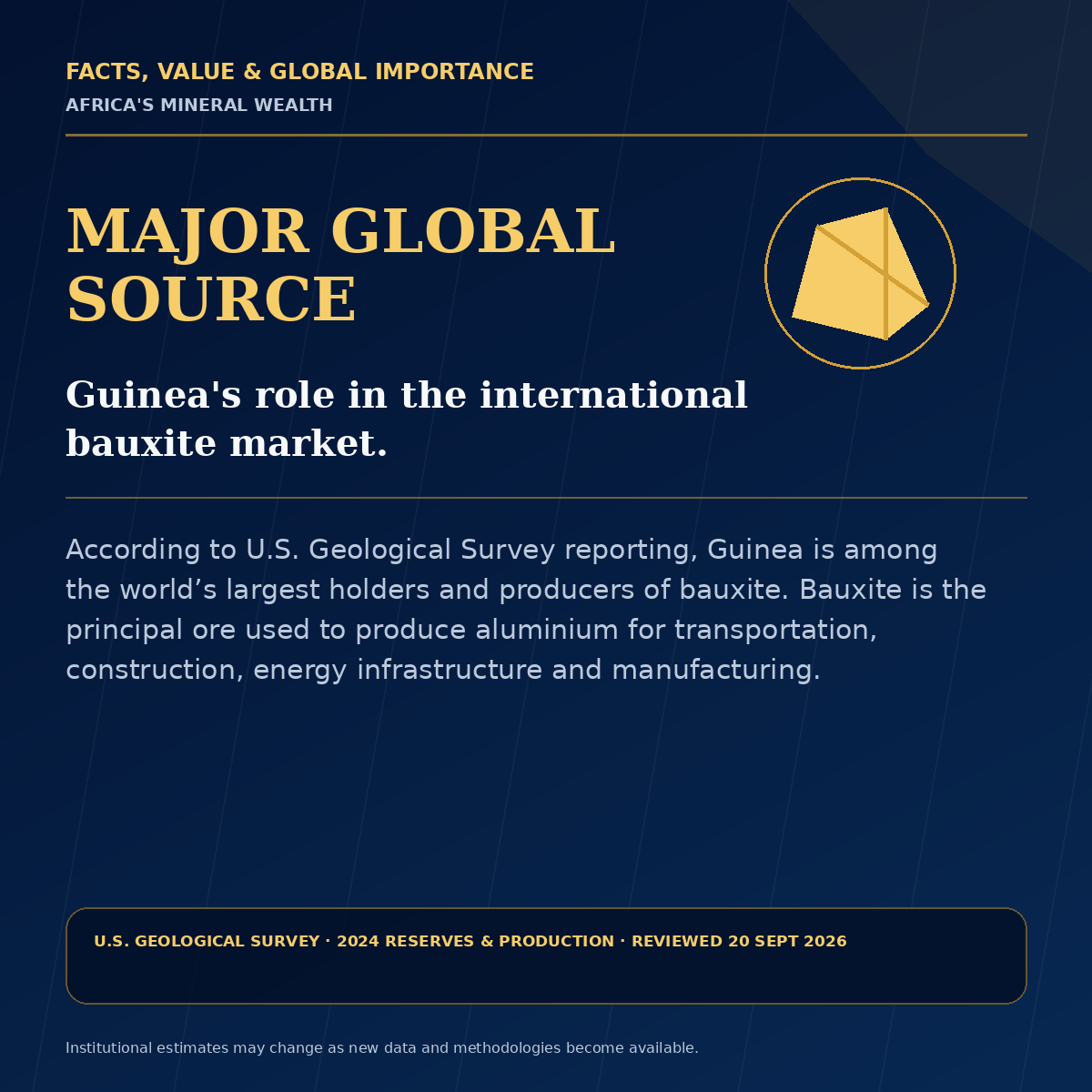
Guinea is a major global source of bauxite by reserves, production and exports. Bauxite is refined into alumina and then smelted into aluminium, a metal used in transport, packaging, construction and transmission.
Most Guinean bauxite is exported unrefined. Domestic alumina refining requires very large capital investment, reliable power and port capacity, which is why local processing remains a central development and financing question for the country.
Source: U.S. Geological Survey — Mineral Commodity Summaries
Manganese and chromium
South Africa and Gabon are significant sources of manganese ore, and South Africa is a leading source of chromite. Manganese is essential to steelmaking and is also used in certain battery chemistries; chromium is essential to stainless steel.
Both commodities are shipped as ore, concentrate or ferroalloy. The difference between those product forms — and the energy cost of smelting — largely determines where value is captured.
Source: U.S. Geological Survey — Mineral Commodity Summaries
Graphite and lithium
Mozambique, Madagascar and Tanzania host substantial natural-graphite resources, while Zimbabwe, Mali, Namibia, the DRC and Ghana have advanced lithium projects. Both minerals are inputs to battery manufacturing: graphite predominantly to anodes, lithium to cathodes and electrolytes.
Graphite is specified by fixed-carbon content, flake size and purification route; lithium by contained lithium oxide and product form such as spodumene concentrate. Battery-grade qualification is a long technical process and should never be assumed from a raw assay.
Gold, diamonds and precious stones
Gold is produced across Ghana, South Africa, Mali, Burkina Faso, Tanzania, Sudan and the DRC, among others. Botswana, the DRC, South Africa, Angola, Namibia and Lesotho are significant diamond sources, and East Africa hosts important coloured-gemstone deposits.
These commodities carry the highest integrity risk in the sector. MIG applies enhanced due diligence including refinery-level provenance, Kimberley Process review for rough diamonds, export-authorisation checks and rejection of anonymous counterparties and cash settlement.
Source: World Bank — Extractives Global Programmatic Support
Why reserves, resources and production are different
A mineral resource is a concentration of material with reasonable prospects for eventual economic extraction. A mineral reserve is the part of a measured or indicated resource that has been shown, through a study, to be economically mineable under defined assumptions. Production is the quantity actually mined and sold in a given period.
These three figures are not interchangeable, and none of them is a valuation. A large resource with no reserve, no licence, no power and no road is not a producing asset. Any figure presented to a counterparty on this platform states clearly whether it is a resource estimate, a reserve estimate or recorded production, together with the reporting standard and the competent person or laboratory responsible.
How local processing creates economic value
The greater part of the economic value in a mineral is usually captured after extraction: in concentration, smelting, refining, alloying and manufacturing. Exporting unprocessed ore transfers that value elsewhere, along with the associated employment and tax base.
Local processing requires reliable energy, skilled labour, transport, water, capital and stable policy. MIG supports processing and beneficiation projects through structured project financing, offtake-linked funding and partner introductions, without asserting that any project will be built, financed or completed.
Source: World Bank — Extractives Global Programmatic Support
Responsible sourcing, environmental protection and community benefits
Access to international buyers and capital now depends on documented conduct as much as on geology. That includes mine-of-origin verification, valid licences, beneficial-ownership transparency, sanctions and politically exposed person screening, and the exclusion of child and forced labour.
It also includes environmental management, water and tailings stewardship, rehabilitation obligations, and demonstrable community benefit through employment, procurement and local development. Artisanal and small-scale mining requires its own assessment rather than exclusion by default.
Source: World Bank — Extractives Global Programmatic Support
MIG's role in connecting qualified participants
MIG Minerals & Metals Capital originates, verifies and structures mineral transactions and project financing between African producers and qualified international buyers, refiners, investors and financing partners. Every participant is identity-checked, every opportunity passes preliminary, compliance, technical and administrative review, and confidential information is released only inside a private deal room after an approved access request.
MIG does not take deposits, hold investor funds, operate a retail investment service, issue tokenised minerals or guarantee any financing, price, grade or transaction outcome. No transaction becomes binding until definitive agreements are executed.
Glossary
Reserves, resources and production are not the same thing
Mineral resource
A concentration of material of economic interest with reasonable prospects for eventual economic extraction. It is an estimate, not a confirmation that mining is viable.
Mineral reserve
The economically mineable part of a measured or indicated resource, demonstrated through a study that includes modifying factors such as mining method, processing, infrastructure, permitting, costs and prices.
Production
The quantity actually mined, processed and sold during a stated period. Production is historical fact; reserves and resources are estimates that change over time.
Why the distinction matters
Resource figures are frequently quoted as though they were reserves, and reserves as though they were revenue. MIG never presents demonstration or unverified figures as confirmed reserves and never publishes a valuation derived by multiplying an estimate by a metal price.
Sources
Data Sources and Methodology
Sources
- U.S. Geological Survey — Mineral Commodity Summaries — Annual reserve and production statistics by commodity and country.
- World Bank — Extractives Global Programmatic Support — Governance, local value addition and development outcomes in extractive sectors.
- International Energy Agency — Critical Minerals — Demand outlooks and supply concentration for energy-transition minerals.
How these figures are maintained
Every statistic on this page is held as an administrator-maintained record with its source, reporting year and last-reviewed date. A review is scheduled at least annually so that outdated figures are not presented as current.
Information is provided for general educational purposes and may change as new data becomes available. It does not constitute investment advice, a mineral-resource estimate, a project valuation, an offer of securities or a guarantee of financing, approval or transaction completion.